Spiritual Reflection 11/2/2025

What happens to us when we die? This is THE classic question! As Catholics we believe that we will stand before Jesus and be judged. Three possibilities await us: hell for those who have totally rejected God, heaven for those who die as saints, and purgatory for everyone else. Of course, we would all like to go directly to heaven when we die, but are you and I living in such a way that we will die as saints? Would it not be more realistic to expect to spend some time being purified in purgatory? Only perfect love can see God face to face, so in purgatory we are purified that we may worthily stand before the face of God.

November is traditionally known as the Month of the Holy Souls, so beginning today and throughout November, we pray especially for all the souls in purgatory.  May they soon be ready to dwell in the heavenly kingdom.

Christians believe that God is all-merciful and that Jesus’ passion, death, and resurrection saved us. However, that does not free us from further purification, as we may still need to make amends for sins committed. This expiation for sin will be made either in this life or in the next. During life, all suffering is redemptive if one accepts it as such, but after death any unexpiated sin needs to be purified. Purgatory purifies the soul of sin leaving it totally pure and ready to come into God’s presence.

The Communion of Saints is the saints in heaven, those who are baptized on Earth, and the souls in purgatory. While we live, we can lessen the time a soul spends in Purgatory through our prayers and sacrifices for them. A particularly powerful means of shortening the time needed for their purification is by having Masses offered for them. Holy Mass is the greatest of all prayers. May I offer a personal anecdote? My father who was a devout Catholic, a devoted husband, and father, said to my siblings and me: “Don’t presume I am in Heaven when I die, please have Masses offered for the happy repose of my soul, just as I did for my parents.”

Traditionally, we name the Church as triumphant (the saints in heaven), the church militant (us on earth, fighting our daily challenges) and the Church suffering (those in purgatory). We are all part of the Communion of Saints! We are united to the saints in their triumph. We are united to the souls in purgatory as they prepare for their eternal reward. Both the saints in heaven and the souls in purgatory pray for us and our intentions. We, in turn, fervently offer the souls in purgatory this often-repeated prayer: “Eternal rest grant unto them, O Lord and let perpetual light shine upon them. May their souls and the souls of all the faithful departed rest in peace.”

Spiritual Reflection 10/19/2025

“Could you pray for me?”
“I’ll prayerfully consider what you said.”
“I’ll pray for you.”
“You haven’t got a prayer.”
“Well, that was an answered prayer!”

We tend to use the word “prayer” in many different ways as we go about our daily lives.  Often, it is part of our vocabulary as people of faith without a second thought.  Even the prayers themselves, especially the common ones, become second nature.  We can recite them without actively thinking about the words – they are part of our routine.  At Mass, after a while, we can get so used to saying the same prayers every week, or every day, that it becomes so ingrained in us that it begins to lack intention.  We know the words so well that they almost speak themselves.

That in itself is not necessarily a bad thing.  There are forms of prayer where the recitation of the words is more like a backdrop against which our internal disposition reaches out to our heavenly Father.  It is a spiritual meditation that allows us to be more fully aware of God’s presence.

But quite often, our routine recitation of prayers is unfortunately far from spiritual meditation; it is often just a “going with the flow.”  We experience this at Mass when, on a random Sunday, the celebrant chooses to recite the Apostle’s Creed instead of the Nicene Creed.  The voices no longer harmonize as usual – little hesitations are heard.  It sounds a bit messy.

And sometimes messy is a good thing.  When we have to pay attention to the words we pray, we are more intentional.  We are more focused.  We are more engaged in our prayer.

And that is where we want to be.  Prayer is the raising of one’s mind and heart to God.  It is an act by which we enter into awareness of a loving communion with God.  And we should do that with our entire being.  We should be fully engaged in this communion – because we know God is.  And a loving relationship can only be fruitful if both parties give it their all.

Developing a fruitful prayer life is a life-long endeavour.  It takes time.  God is patient – he never tires.  He is faithful, even when we falter in our faithfulness.  He offers reconciliation when we stray from the path.

So let us not only be persistent in our prayers – let us be persistent in our desire to learn to pray more intentionally, with our whole mind and heart. There is nothing greater than a loving communion with God.

Spiritual Reflection 10/12/2025

Last week, we celebrated the feast of St. Francis. There is a legendary story of a fierce wolf that had been terrorizing the Italian town of Gubbio, killing some of the people, including children. St. Francis is visiting the town and, according to the story, when the wolf sees St. Francis, he charges at the saint with his mouth open, ready to attack. St. Francis immediately makes the sign of the cross over him and says, “Come here, Brother Wolf. I command you on behalf of Christ that you do no harm to me or to anyone.” As soon as St. Francis did this, “the fearsome wolf closed his mouth and stopped running; and once the command was given, it came meekly as a lamb, and threw itself at the feet of St. Francis.” Then Francis scolds the wolf for destroying and killing the creatures of God. “The whole town is complaining about you,” Francis tells the wolf gently. “But I want to make peace between you and the people. And so, I promise that I will have food given to you regularly, by the people of this town, so that you will no longer suffer hunger.  And I want you, Brother Wolf, to promise that you will never harm any human person or animal.”

The wolf showed agreement by simply bowing his head. And so Francis asks the people of the town if they will promise to provide food for the wolf regularly. They agreed. “Afterwards, that same wolf lived in that town for two years, and he tamely entered the houses, going from door to door,  without doing any harm to anyone and without any being done to him; and he was kindly fed by the people. Finally, after two years, Brother Wolf died of old age, at which the citizens grieved very much.”

We might say – oh, that is just a story or just a legend. We may ask, did that really happen? However, we see this story played out in the lives of the saints. The narrative of the wolf is hidden in the life of St. Maria Goretti and her mom, Assunta, who forgave her daughter’s rapist and killer, Alessandro. Not only did Maria’s mom forgive the wolf in her life, Alessandro, she called him her son. While in jail, Assunta requested that they attend Midnight Mass together.  There, they humbly received the Eucharist, kneeling side by side.  Twenty-one years later, they knelt again, this time in Rome, among a quarter of a million people with tears in their eyes as Maria was canonized a Saint.

We see this kind of love conquer wolves over and over again in the lives of the saints. This narrative is so important to soak in right now because in our country, in recent weeks,  we have come face-to-face with brutality, anger, and hatred in their ugliest forms. Emotions run high in these difficult times. It is precisely in these moments that we must look to the examples of the saints and ask for their intercession, so that we can become peacemakers to the wolves in our lives.

Spiritual Reflection 9/21/2025

In 2015, Catholic singer Matt Maher released the song “A future not my own”, in which we hear the following lyrics:

We see the start but you see the end
We see in part but your love sees everything
We plant the seeds but you make them grow
We’re building a house, you’re building a home

This is the great unknown
Love is a long and narrow road
Come chase this heart of stone
I need a future not my own

This world is not my home
I still have miles and miles to go
Come break this heart of stone
I need a future not my own

This is what the readings for the past several weeks have been about.  You might even say that this is what Christianity is all about.  Through baptism we have been reborn into a new life.  A life that is destined to be eternal, through our sharing in the divine life of Christ.  It is what we were created for.  But it is not something we can earn – it is a gift from God.

But it is mysterious… we cannot see what that eternal life truly will be like.  On the other hand, our life here on earth is very concrete.   Our earthly existence is what we can see – and in the context of eternal life, it is the start that we see.  But God sees all – he sees the glorious end that is not a chronological end but rather a state of eternal glory.

We can try to imagine what that eternal life with God may look like but we cannot know it while we roam this earth.  We cannot even really conceive of it because it is not of our making.  Everything that is our doing, of our making, is finite and earthly.  It can make us happy in the here and now, but it has no real future.  Eternal life is an aspect of the divine life.

And yet, we spend so much time focusing on our earthly existence.  We tend to associate happiness with success.  We tend to spend a lot of energy and resources on avoiding hardships and suffering.  We try to pursue the things in life that make us happy – or at least, that make us feel good.  We pursue the things that contribute to establishing a comfortable future – an earthly future

But do we give as much attention to our real future?  The future that we were created for?  The future that is not our own – the future God wants for us?

Spiritual Reflection 9/7/2025

When I was much younger, I was perplexed by Jesus’ use of the word “hate” as in the beginning of this Sunday’s Gospel. However, I discovered that in the Hebrew dialect that Jesus spoke, “hate” was a Semitic expression. Today we should not take it literally. We now think of it as telling us that loving God is more important than anything else. Jesus asks us to put Him first in our hearts. He certainly is not asking us to abandon our families! In the society in which Jesus lived, people’s entire lives centered on their families, as we do also. Jesus used extreme language so that we would not forget what He was asking: namely, our wholehearted commitment to follow His way, live His truth, and share life with Him. The question is: just how important is God in our lives?

When Jesus proclaimed today’s Gospel message, He was on his way to Jerusalem to undergo extreme suffering, to redeem us, and to demonstrate His tremendous love for us. He does ask us however, to share in His suffering so as to attain the reward of eternal life. “Whoever does not carry his own cross and come after me cannot be my disciple” (Luke 14:27). We can take comfort in Jesus’ promise to be with us today and always and to give us the grace and strength to carry our cross. So, invite Him into your heart and He will invite you to follow Him more closely

Discipleship means freedom to love Jesus and others and to say “no” to what holds us back. For example, St. Francis of Assisi left his family and shed his rich and fancy clothes and clothed himself in beggars’ rags. Only then was he filled with tremendous joy and freedom. Dare I ask myself at this stage on my own journey, what I am willing to leave behind to embrace true discipleship?

If I put Jesus as a personal priority, I will find inner peace and grace, even through difficult moments and whatever it is that God sends my way. May it be so!

God bless you!
Sr. Kathleen

Spiritual Reflection 8/31/2025

Catholic Podcasts Nourishment for Your Soul

The Catholic tradition has always held Spiritual Reading in high regard and has recommended it to those who wish to grow closer to God. Perhaps in our day and age, Spiritual Listening may be more the trend.

What follows is a list of Catholic Podcasts that will help to make this spiritual practice available for you in your daily life. Listen in your room, your car, outside (when the weather permits) or in your favorite place to sit and relax. You will be happy and enriched because you have embraced this practice. Sometimes dedicating a specific time or place helps you in being faithful to this practice.

All of these Podcasts are available using the podcast app found on most smart phones or i-pads.

*Catholic Morning Offering
*Word on Fire (Bishop Barron)
*Catholic Saints
*Discerning Hearts
*A Rosary Companion
*The God Minute
*American Catholic History
*Vatican Insider
*The Bible in a Year
*Life is Worth Living (Sheen)
*God in All Things

Happy listening!

Spiritual Reflection 8/24/2025

I expect I am not alone in saying that, if I am truly honest with myself, I sometimes look at God as the provider of “good things”.  That sentiment is expressed in the responsorial psalm where we hear: “[…] steadfast is his kindness toward us, and the fidelity of the LORD endures forever.”

Who would not want to focus on that?  If the fidelity of the Lord endures forever, and his kindness toward us is steadfast, then surely he wants the best for us.  He wants us to be happy.  And we can call upon him in our need.  And all that is true!

But the relationship between God and man is not one where God serves us.  He is Almighty God.  He is the creator; we are the created.  Let us not forget that.

God is also our Father.  Through the Paschal Sacrifice of Jesus Christ, we share in the divine Sonship.  That is a blessing beyond compare.  But as we heard Jesus teach his disciples a few weeks ago: “Much will be required of the person entrusted with much, and still more will be demanded of the person entrusted with more.”  If we receive a share in the divine life through the death and resurrection of our Lord Jesus, I think it is fair to say that we have been entrusted with “more.”  A lot more.  So let us not forget that a lot will be demanded of us.

Last week, we heard the first part of this.  There will be division.  Living our faith will cause conflict, division, and sometimes even rejection.  But we cannot compromise our faith.  There is no way to “kind of” believe in God.  There is no way to “kind of” living the Christian faith.

This week, Jesus explains why we need to be firm in our faith.  There will come a time when the master will lock the door, and he will not admit anyone beyond that time.  This is the day of judgment.  And we already learnt weeks ago that this will happen at an unknown day and time.  If we are lukewarm about our faith, and act as the servant who sees his master is delayed, and puts his focus on having a good time, we will be caught unaware.  And the consequences are dire.

Let us rejoice that Almighty God is our Father, and that because of our share in the divine Sonship, God treats us as “sons”.  As St. Paul writes: “[…] what “son” is there whom his father does not discipline?  At the time, all discipline seems a cause not for joy but for pain, yet later it brings the peaceful fruit of righteousness to those who are trained by it.”  God the Father helps us lovingly, as a father would, to prepare us.  Because He wants “people […] from the east and the west and from the north and the south […] recline at table in the kingdom of God.”  He does not want us to be cast out – locked out when the Master locks the door.

Our faith is likely to lead to trials and hardships.  God is with us, and as a Father, he lovingly instructs us and guides us, to strengthen us, so that when the time comes, we can be faithful and prudent servants, blessed by our Father in Heaven, reclined at table with Abraham, Isaac, and Jacob and all the prophets in the kingdom of God.

Spiritual Reflection 8/3/2025

Heavenly Treasure

A little over a year ago, I had the privilege of attending the National Eucharistic Congress in Indianapolis. The deep faith and overflowing joy of sixty-thousand people of all ages and paths in life seeking “Heavenly Treasure” was extremely inspiring. Their praise and adoration of Jesus in the Most Blessed Sacrament is indelibly etched in my heart.  In the Gospel next weekend, Luke tells us, “Where your treasure is, there also will your heart be” (Lk. 12:35).  So … where is my heart, … what is my treasure? Truthfully, answering this question, desiring to open one’s heart to the transforming love of Jesus Christ, one will find “Heavenly Treasure.”

When one responds to the grace of God, that ‘Treasure in Heaven’ will be obtained. The readings next week suggest three pathways toward building up this treasure: being aware and awake, giving alms and spiritual gifts, and trusting in God’s faithfulness.

Awareness is the point of departure for a spiritual journey. Faithful attendance at Mass, frequent reception of the sacraments, especially the Holy Eucharist, silence, meditation and prayer are the sure means of gaining spiritual treasure. Being awake is tied to readiness and hope: “Happy those servants whom the master finds awake when he comes” (Lk. 12:43). We are called to be alert to the action of God in our hearts and in our lives. Even amidst the busy schedule of daily life we can remain God-centered if we are open to the graces that He offers us.

Jesus invites us to “Sell your belongings and give alms” (Lk. 12:33). Giving away your material possessions to people in need, is a way to gain ‘Treasure in Heaven’. In addition to freely donating money or material goods to the poor, we can gather spiritual gifts. These include: acts of love, personal penances and the sacrifices that we make. By patiently enduring the little inconveniences of daily life and “offering them up”, we present a pleasing gift to our God.

The third means of building ‘Treasure in Heaven’ is faith. A verse from Hebrews invites us to focus on the primacy of God in our lives, because “Only faith can guarantee the blessings that we hope for, or prove the existence of the realities that at present remain unseen” (Heb. 11:1). Constant practice of the virtue of faith draws us closer to God and to one another in love. 

What is the blessing that is promised to those who are spiritually awake, give alms to the needy, and offer spiritual gifts to God? It is the ultimate blessing of the “Heavenly Treasure” … Eternal Life.

God bless you!
Sr. Kathleen

Spiritual Reflection 7/27/2025

I would like to express my most sincere thanks for your prayers, support, and generosity.  The past seven years have been a true blessing as I continued to discern the Permanent Diaconate and went through spiritual, academic, and pastoral formation.  But it was also daunting at times, balancing home, work, and formation.  Your continued prayers and words of support have been instrumental in helping me and my family along the path towards my ordination.  Please continue to pray for me and my family as we adjust to my new role at the parish, and be assured of my prayers for you all.

Prayer is central to our faith.  In fact, it is essential to our faith life, because it is how we interact with God.  It is how we can have a vital and personal relationship with the living and true God.  St. Thérèse of Lisieux says: “For me, prayer is a surge of the heart; it is a simple look turned toward heaven, it is a cry of recognition and of love, embracing both trial and joy.”

Today’s readings highlight a very important aspect of this relationship.  As Jesus points out in the prayer he teaches his disciples and in the subsequent discourse about persistence in prayer, there is a filial relationship underlying our prayers to God.  We can truly call God our Father because we are his adopted children through baptism.

At first glance, that might not really be significant but it has a tremendous effect on our relationship with God and our prayer life.  We might be inclined to think that our prayer is a way to present our needs and wants to God.  Perhaps we look beyond that, and see it as a way to have a dialogue with our Lord.  And that is not incorrect.

But it is important to realize that God is indeed Our Father – that we are his adopted sons and daughters through Christ’s death and resurrection.  And Jesus tells us that our prayer life is therefore part of a child-father relationship rather than a servant-master relationship.  This is why Jesus says: “What father […] would hand his son a snake when he asks for a fish?”

God is not merely our Father though – he is the perfect Father.  We often do not see it that way, because we tend to regard God through the lens of our human imperfection.  But it really should be the other way around.  God is perfect, and earthly fatherhood is an imperfect reflection of that.  To quote Jesus: “If [human fathers] know how to give good gifts to [their] children, how much more will the Father in heaven give the Holy Spirit to those who ask him?”

As we pray, let us remember that we are participating in a dialogue with our perfect Father in heaven, who initiated the dialogue and is patiently awaiting our response.  Let us speak to him from the heart, sharing our joys and our sorrows, our blessings and our needs, and know that as a perfect Father, he hears us and will answer in the way that is best for us.

Spiritual Reflection 7/20/2025

This little story of Martha and Mary has a way of getting into people’s minds; it has a way of getting under people’s skin. Many people over the years have complained about this story, in which they believe that it’s not about Martha and Mary, but rather about Martha versus Mary: Who leads the best life? Even my mom, every time she hears this Gospel, strongly defends Martha, telling me that Martha gets a bad rap.  I think people take a stance on this because they, too, identify with Martha and believe it was an unfair assessment on Jesus’s part. Martha, who was worried about all the details of hospitality, represents the active life. She represents the people who get things done in life, all those people in the life of the Church who are actively engaged in their Ministry. Mary, on the other hand, sits quietly at the feet of Jesus and listens, representing the meditative life. Think of all the monks and nuns and scholars who spend their lives in quiet considering the things of God.

Now, when Jesus says to Mary, “you have chosen the better part and it won’t be denied of you,” is read by some as Jesus valuing the meditative life over the active life. Honestly, I will not go that far with it, but I think we can reflect on this active/meditative life. I think that it is made very clear in the Old and New Testaments that listening has to come before acting. Now I am not saying that action is not important, but it is more of a chronological relationship: Step 1: listen, Step 2: act.

What gets people in trouble is that we may act without listening. Think of King David in the Bible when he wanted to build the temple. It was good to want to build a temple for God. David was full of good intentions, but that was not part of God’s will at that very moment. As Nathan the prophet said, “No, that is not what God wants.” David, to his credit, listened and did not act. Or even better, he acted by not building the temple. Action after taking the time to meditate is a very important principle for us today. 

We are not a very meditative society – we are much more action-oriented. We are much more at home with Martha as we prefer to keep busy and very active. In our culture, it seems like we are people who never stop moving.  We go from place to place, meeting to meeting, dropping one child off at one activity, and trying not to be late for our next appointment. Action is good, but being too busy isn’t. So then, action without prayerful reflection is problematic: We must listen first, then act.

Have you ever noticed in the Gospels that we never hear Jesus do things out of obligation? He doesn’t say, “I guess I should do this because I am supposed to.” This is the tension that we feel when reading the Gospels. It is the tension that we have with Him now. Jesus is willing to go against the expectations of the crowd, even when it comes to his friends Martha and Mary. In order to be true to the things that He is pursuing, Jesus doesn’t let what everyone wants or what the culture thinks is the most noble for him to do to redirect His purpose.  His purpose was always the cross. His purpose was to head towards Jerusalem.

So again, we never see Jesus stressed or worried that He is going to let people down. He doesn’t cure everyone who is blind, paralyzed, and deaf. He was never worried about what people thought about him.  We never hear Jesus say, “I am just so busy!!” The truth is that for us, being busy is a drug that is easy to become addicted to.

Obviously, there are times in life that we just can’t help but be busy: a sick family member, starting a new job or new project at school or work, or typical family life. Today’s Gospel, however, tells us that we must examine the rhythms of our lives, the busyness, with the help of God. We have to if we are ever going to stay focused on the great things that God has planned for us.

Let’s ask ourselves: Are we going through the motions of life, or do we know exactly what our lives are about? We all have God given talents and gifts. We all get the opportunity to receive God’s life in the sacraments.  We have the graces ready to be given to us; however, if we don’t spend time praying about these things, thinking about these things, and sitting in silence with God to listen to Him, we can get pulled off track and get spread too thin. We can be like Martha complaining to Jesus about Mary; we complain to ourselves and others about how busy we are and others are not. However, if we stay focused on what God wants from us and on the important things in our lives, we can begin to truly listen to Jesus and have more confidence in Him as we pursue the great things in this life.

So let us think about this today, especially for those who feel so busy right now. Know that God is not asking us to do more, but that He is probably asking us to do less. Let us take a moment out of our busy lives to be with Him, to go out and smell the roses of life, to learn to enjoy being present with God.  Let us understand more of what God has created us to be so that we don’t get burned out on our journey to heaven.

Spiritual Reflection 7/13/2025

On this 15th Sunday in Ordinary Time, we celebrate the God who is close to us in our neighbor. As the image of the unseen God, and as the Good Samaritan, Christ is near us in every circumstance of life, especially when we reach out in selfless love to our neighbor. Reflections by Saint Teresa of Calcutta and Pope Leo XIV enrich our minds and hearts with the spiritual depth that Jesus conveys in this parable.

“Every person is Jesus,” said Mother Teresa. The Samaritan finds a man beat up and bloody, and sees Jesus lying in the gutter. He treats him with mercy and compassion. To those who do not show mercy God is invisible. As St. Paul writes in the second reading: Christ Jesus is the image of the invisible God. Saint Teresa of Calcutta adds: “The poor person is the image of the invisible Jesus. Jesus comes to us in every person we encounter and He reveals the face of God to us in them.” Can we see Jesus in the poor, the troublesome, the annoying person?

One time Mother Teresa was talking to a group of American professionals. “Smile at each other,” she said. Smile at your wife, smile at your husband, smile at your children, smile at each other – it doesn’t matter who it is – and that will help you grow in greater love for each other. One of the women asked her, “Mother, are you married?” She responded: “Yes, I am, and sometimes Jesus asks a great deal of me, and it is hard to smile at Him!” In spite of the difficulty, Mother Teresa kept on smiling. Can we do the same, even in times of trial and suffering?

In today’s Gospel, Jesus tells the parable of a priest and a Levite. We would imagine that each would have stopped and cared for the hurt man but they simply chose to ignore him. This, Pope Leo highlights, shows that “religious practice alone does not automatically lead to compassion.” Compassion is not necessarily a characteristic of religion but is characteristic of being human. Human beings are called to be compassionate, no matter what their religion is. The priest and the Levite represent all of us – in a hurry to get somewhere. This hurry can keep us from reaching out, being compassionate. Pope Leo warns, “People who believe their journey takes priority are not willing to stop for others.”

Only a Samaritan, “someone from a people traditionally despised,” stops to assist the wounded man. The Samaritan helps, not out of a religious requirement, but because “he is one human being in need in front of another human being.” Compassion, Pope Leo stressed, takes form through concrete actions, because in order to help someone, “you cannot stay at a distance.” To be compassionate, one has to get involved and be prepared to “even get dirty, and perhaps take risks.”

The Samaritan is an example of compassion because he physically takes care of the wounded man. The Pope underlines that truly helping someone “means being willing to feel the weight of another’s pain.” He points out that only when we recognize that we ourselves are the wounded man can we truly feel compassion.

Let us pray for the grace to always respond with heartfelt mercy and compassion to relieve the suffering of others!

May God bless you!
Sr. Kathleen

Spiritual Reflection 7/6/2025

On behalf of our entire school family, I would like to extend our deepest gratitude to the Sisters, Servants of the Immaculate Heart of Mary, for their decades of faithful service, unwavering dedication, and spiritual leadership at Queen of Angels Regional Catholic School. Their presence has and will continue to be a blessing, shaping the hearts and minds of generations with love, faith, and excellence.

As we look ahead, I am pleased to introduce Ms. Beatrice Allen as our new and first lay principal. Ms. Allen brings a deep commitment to Catholic education, a passion for student success, and a collaborative spirit that I am confident will guide our school into a bright and faithful future. Ms. Allen had the opportunity to come and meet with some of our families and faculty at the Home and School Student Showcase at the end of the school year. She shared her thoughts on becoming the Principal here at QOA and I would like to share them here:

“Good Evening, everyone. I am honored, I am overjoyed, and I am humbled to stand before you tonight. This moment represents a turning point in my life as well as a turning point in the life of Queen of Angels Regional Catholic School.

Taking the first step on an untraveled path is both exciting and scary. As you focus on moving forward, it is hard not to stop, turn your head and look at what is behind you. In fact, it is important that you do take the time to stop and look at what is behind you because that is your legacy; it is your history. It is what brought you to this exact point in time. That pause, that turning of the head, is the time to reflect on what you will carry with you as you journey forward and what will become a treasured memory. It is time to think about where you were and where you can and want to go. In fact, it is the time to look up and look within… and be confident that God’s grace is truly leading the way.

As a young girl, all I ever wanted to become was a teacher. I was blessed to live my dream; I have been in Catholic education my entire career. A few years ago, I decided I wanted to impact more than just a classroom filled with students. I wanted to impact a school filled with students as well as teachers who shared my dedication, devotion and enthusiasm for Catholic education. So, as my one and only daughter headed off to college, I did as well. I can honestly say it was the most challenging yet rewarding time of my life. While I may have felt overwhelmed and overworked at times, I knew I was never alone. I had the unwavering support of my family, my friends, and my faith. ALWAYS my faith.”

Please join me in praying for the IHM Sisters as they continue their ministry here at Queen of Angels and beyond, and in welcoming Ms. Allen with open arms and warm hearts.  I thank you all for your support of Queen of Angels.

God Bless,
Mrs. O’Doherty
Spiritual Reflection 6/29/2025

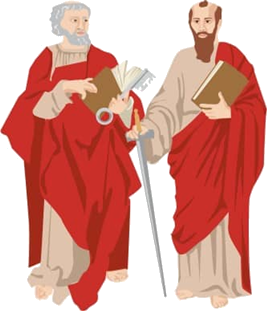
The Solemnity of Saints Peter and Paul

Saint Paul recalls the zeal of his early years within Judaism, when he persecuted the Church and tried to destroy it.  He points out that he followed the Jewish practices to the letter.  Yet, in the plan of God, Paul was destined to preach the gospel to the gentiles.  Because of this divine plan, he had no need for human teachers or for any direction from the Church at Jerusalem.  After his conversion, he set off for an area south of Damascus, which he called Arabia.  He then returned to Damascus, and, after three years of prayer and reflection, he went to Jerusalem.

Paul speaks of visiting with Peter, whom he calls by his Aramaic name, Cephas. The name Cephas and Peter both mean “rock.”  The visit apparently consisted of no more than just getting acquainted.  Peter and Paul shared an understanding of their teachings with each other.  Paul spent only fifteen days with Peter, hardly enough time for any deep lessons of faith.  At that time, the only other disciple Paul met was James, the head of the Jerusalem Church (not James the Apostle), who is referred to as the brother of Jesus in the Acts of the Apostles.  This reference to James as Jesus’ brother may mean that he is related to Jesus in some manner, for in Jesus’ culture a cousin could be referred to as one’s brother.

Paul when went to Syria and Cilicia, and he describes the reaction of the Christians of Judea to his ministry. Although they did not know him personally, they had heard that he was the one who had previously persecuted the Church and was now preaching the faith.  They praised God for this gift, thus showing that they accepted Paul as a true disciple of Jesus.  Some of the Judean Christians would later become the ones to reject Paul’s teachings and cause him to eventually turn this attention to the Gentiles.

Spiritual Reflection 6/22/2025

God Travels Too

When Judah was defeated by the Babylonians, many of the Jews were taken as hostages back to Babylon. This was devasting to the Jews because not only were they being taken away from their homeland, but they believed that they were being taken away from God who they believed resided only in Judah, where the temple was.  They were forced to participate in local rituals and customs even though these things went against their own teachings of their faith. 

There were a few who refused to participate and held fast to the teachings and relationships that they had with God. Daniel, Hananiah, Mishael, and Azariah were four young men who did not give up on God. It was through their faith that God let them know He was always with them wherever they may be. Daniel was, of course, spared in the lion’s den, and Hananiah, Mishael and Azariah were saved from the fiery furnace. In fact, a fourth person was seen in the fire with the three young men, one who looked like, “the Son of God.” Jesus was with them.

We need to remember that no matter where we live or where we travel to that God is always with us. He is always with us – with a burning love for us.  When we are traveling this summer on our vacations, we need to recognize this.  Our relationship with God travels with us, which means we need to attend Mass even while we are away. Holding fast to our faith can and will have the same outcome as it did for the four young Israelites – salvation from beasts and an eternal fire.  We are asked not to get caught up in “local customs” and to attend Mass through our constant faith. It is at Mass where we will receive the very Savior in His Body and Precious Blood – that very gift of the Eucharist we celebrate today. 

Just think of the traditions we are establishing with our children and grandchildren that even while we are away – we always put God first. Remember, God loves spending time with us, even on vacation.  Find a Church, they are everywhere.

May Jesus live in our hearts forever.
Deacon Chris

Spiritual Reflection 6/8/2025

The Holy Spirit in Our Lives

As we celebrate the coming of the Holy Spirit on this Pentecost Sunday, let us praise and thank God for the times we have experienced the inspiration of the Holy Spirit in our own lives. Through the grace of the sacraments, every time we choose to follow God’s will, instead of our own, we are responding to the presence of the Holy Spirit in our hearts.

Under the leadership of our Pastor, Fr. Matthew Windle, the parish staff and the school and convent leaders have been gathering each week to strive to deepen our personal prayer lives, so we can more faithfully guide all St. David Parishioners to embrace our parish vision:

“Knowing that Jesus is the best gift that any person can receive; that we have encountered him is the best thing that has happened in our lives, and making him known by our word and deeds is our joy.”
~ Pope Benedict XVI  

Through the inspiration of the Holy Spirit, who used the vehicles of our group sharing and the insights of a program on prayer entitled, “Oremus” I personally felt impelled to revise my prayer life. The Holy Spirit enlightened me to realize that I was devoting too much time each day to vocal prayer and not enough time to striving to grow in reflective/contemplative prayer. Therefore, I was drawn to decrease my vocal prayer to a single rosary and to spend a minimum of one hour daily reflecting on a short passage from Sacred Scripture so that I may be able to more clearly hear God’s Word. I found the steps below which have helped countless seekers to grow in their personal relationship with God, to be quite beneficial:

  • Pray to the Holy Spirit to guide me to the Scripture Reading and the particular phrase for my prayerful reflection that day (usually from the daily Mass Readings). I read the passage slowly and reflectively two or three times.
  • Acknowledge – God knows every facet of our lives – our joys and our sufferings. He wants us to put our successes and our failures into his hands, trusting in his love and forgiveness.
  • Relate – God desires our true selves, for it is the heart that prays, with all its strengths and weaknesses.
  • Receive – I invoke the Holy Spirit to fill my heart with his abiding love and peace!

God speaks to us in SILENCE! BE STILL and LISTEN!

  • Respond – I resolve to follow the inspiration of the Holy Spirit given to me.

Words are inadequate to express the tremendous increase of joy and peace I have experienced through the inspiration of the Holy Spirit to revise my prayer life. My prayers are joined with yours that as a parish we may either respond or continue responding to the Holy Spirit’s inspiration to deepen our relationship with God!

Holy Spirit enlighten us!
Sr. Kathleen Fitzpatrick, IHM

Spiritual Reflection 6/1/2025

The Gospel passage for this Sunday gives us the unique opportunity to hear Jesus and how he prays to the Father.  There are two things that struck me in this Gospel. 

First, Jesus prays that we may be one as he and the Father are one.  In the past month, there has been a lot of discussion and analysis of the Papacy.  During the Conclave, there was much discussion on what the new pope should focus on.  Bishop Barron responded to these concerns at the time by saying, “The key task of the Pope, in his own person, is summing up the unity of the Church…. He is supposed to be someone where the entire Church finds its unity.”  Jesus wants us (all Christians) to be one.  How can we work, each day, to bring that unity into reality?

The second thing that struck me from the Gospel was when Jesus said, “Father, they are your gift to me.”  I am not sure that we reflect on that fact enough.  Jesus sees us as a gift!  We are precious to him!  When we are having good days, he sees us as a gift. When we are having bad days, he sees us as a gift.  We cannot change how Jesus views us!  We don’t have that power! (Thank the Lord!)  The next step would be, how can we be a gift to others? 

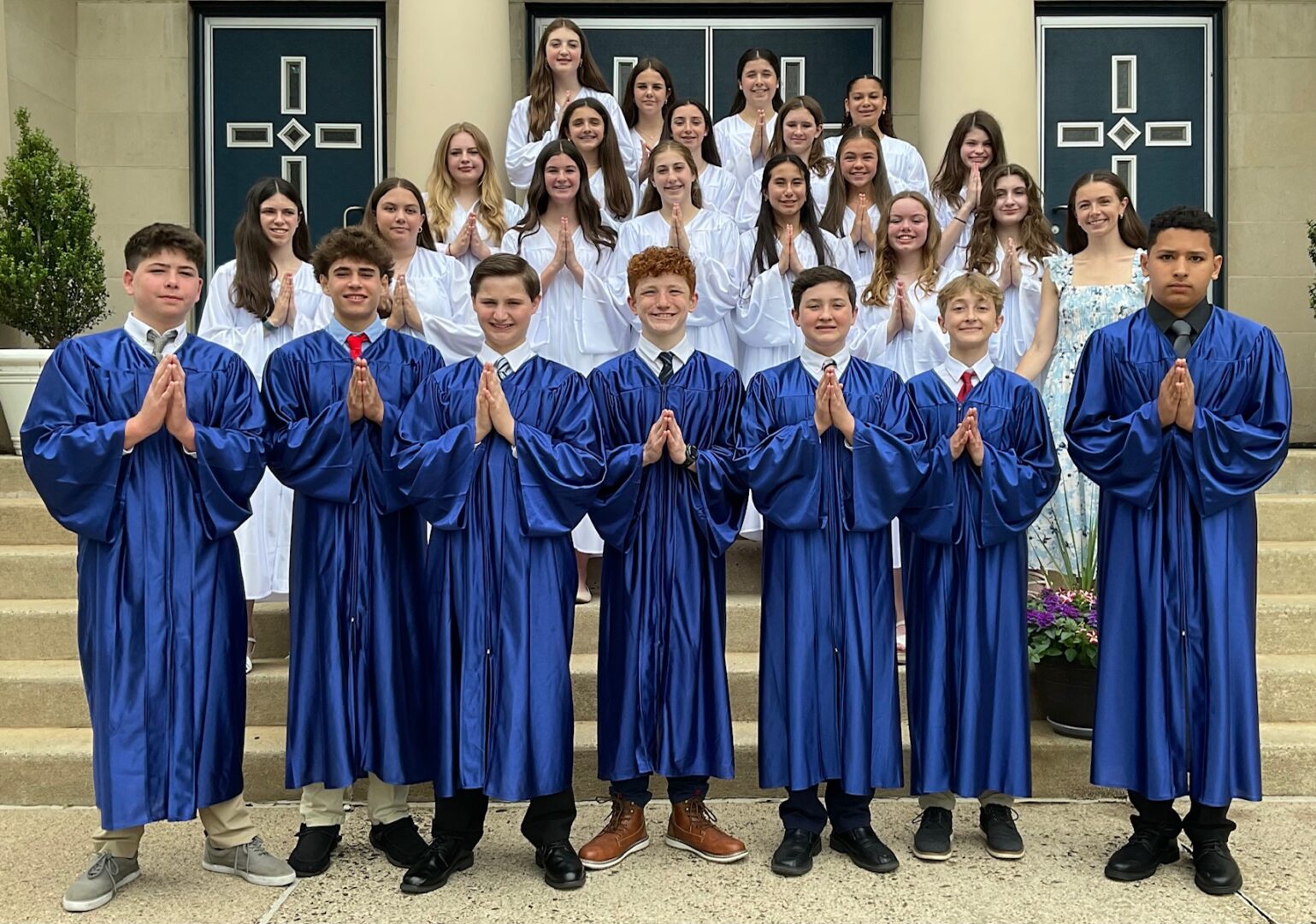
Today, at 2pm, Queen of Angels’ 8th grade class is having their Graduation Mass at Our Lady Help of Christians.  They are moving on to their next step in their academic lives.  They are going forth to work for that unity and be a gift to others.  Congratulations to the QOA Class of 2025!  We are so excited to witness all that you will do in the future!

Spiritual Reflection 5/4/2025

MARY, MOTHER OF THE EUCHARIST

       The Bible tells of a great love story between God and his people. We have been loved into existence. Created by love and for love—the eternal love of heaven. Even despite our sins, “God so loved the world that he gave his only Son, so that everyone who believes in him might not perish but might have eternal life” (John 3:16). God’s love has redeemed the world.

But this great love story hung upon a “yes” of a young teenager named Mary.

In giving God her simple and total “yes,” Mary became the Mother of God. Thirty-three years later, Jesus would give her to us, so that she would become the Mother of the Church. Now each of us can claim Mary as our own. We rely on Jesus’ Mother for her prayers and trust her to assist us in our spiritual walk.

Though she never steals the spotlight from her Son, we can garner assuring glimpses of her compassion and powerful intercession in Scripture. At the wedding feast of Cana, we see her bring the newly married couple’s need to Jesus, and Jesus responds by performing his first public miracle. At the Crucifixion of Christ, while many of Jesus’ closest followers were in hiding, we find Mary at the foot of the Cross, proving she is willing to be close to pain and suffering.

In our Blessed Mother, we find more than an advocate; we also find an example of how to relish God’s presence. One of the few Gospel passages that describe Mary’s actions is Luke 2:19, “And Mary kept all these things, reflecting on them in her heart.” Here we catch a glimpse of her life of fruitful prayer, meditating upon all that Jesus has said and done. When Jesus walked amongst humanity, how many people passed him by without recognizing the gift of his proximity? Mary was always aware of who Jesus was and the importance of his nearness.

God chose Mary to bring forth Christ into this world. For nine months, Mary was a living tabernacle. Christ physically dwelled within her. As we go into the world, we too can be living tabernacles as Christ dwells within us through our participation in the Sacred Liturgy and the Eucharist.

As disciples of Christ, we must allow Mary to draw us close to her Son. St. Pope John Paul II wrote in Ecclesia de Eucharistia, “Mary can guide us toward this most holy sacrament because she herself has a profound relationship with it.” Mary’s mindfulness, faithfulness, and devotion drew her close to Jesus, and following her example can help us do the same. Today, let us follow Mary’s example and reflect on the love of Jesus in our hearts.

Spark Series of the Eucharistic Revival

Spiritual Reflection 4/27/2025

Today, we read in the Gospel that Thomas was absent from the group, and therefore, missed Jesus appearing to the other Apostles.  Thomas was away from the other Apostles, and so, he was away from the Church. The Gospel doesn’t share what Thomas was doing.  Maybe he was not afraid like the other Apostles, so he was not hiding. Whatever Thomas was doing, it led him away from the group – from the Church.

I know that there are times that we have the best of intentions, and those good intentions can take us away from what we should be doing.  One thing to be aware of is not to lose the discipline and growth you have gained from your Lenten sacrifice.  Easter doesn’t mean throwing away or picking up whatever you added on or gave up. 

On the contrary, Easter is a time to celebrate your growth in your relationship with Jesus Christ!  Learn from Thomas’ experience!  Don’t separate yourself from the group! Can you believe that a week ago, we celebrated Easter?! The Church in her wisdom gives us eight days to celebrate Easter!  That means, for eight days after Easter, we can treat each day as if it is Easter Sunday! 

This Sunday is also called Divine Mercy Sunday.  Pope John Paul II established the Sunday after Easter to be Divine Mercy Sunday.  Please take some time to read about St. Faustina and the Divine Mercy revelations!  Just google St. Faustina, there is so much information out there on this special message of Mercy from Jesus!  Happy Easter!

Spiritual Reflection 4/20/2025

Happy Easter! Jesus has risen from the dead, Alleluia, Alleluia! Do we believe this?

         In John 11 after Lazarus dies, Martha tried to find Jesus in her grief. When she does, she says, “Lord, if you were here, my brother would not have died, but even now I know whatever you ask of God, God will give you.” Jesus replied, “Your brother will rise,” and a few sentences later he talks about the resurrection of life and asks, “do you believe this?” Well, I remember one time reading this at a funeral service. When the time came for the question to be asked “Do you believe this,” the granddaughter of the deceased – about 4 years old – screamed out, “Yes! Yes, I believe!” in the middle of the reading. While everyone else in the room had tears in their eyes, she with a huge smile on her face, said again, “Yes, I believe.  People started to laugh, and she brought smiles to everyone’s faces who were there to mourn that day.

Do we believe that death is not the last period on human life? Do we believe that life is? Do we believe that Death is not the last word in the sentence of life?  Do we believe that the last words are resurrection and life that has no end? This past year there have been so many people who have shared their crosses with me. Crosses that just seem so heavy to bear. One family shared with me their heavy cross that they were carrying with their child who had cancer. They then found out that the wife was diagnosed with cancer too. Do we believe in the midst of suffering? There are a lot times I can remember being personally challenged to answer that question.  As a seminarian, I was challenged when I found out that my friend Brian died in a motorcycle accident. I rushed over to see his mom.  When I got to the house, she was lying on the floor crying and screaming, “Why God? Why God?”  Not only did she lose her son suddenly, but she had suddenly lost her husband a few years prior as well.  All she could do was just scream on the floor, grab my hand with one hand, and hold her rosary with the other.

Do we believe that death is not the end? I was challenged by this question my first year as priest going to a call of 16 old boy who committed suicide. I arrived to a full house of his brothers, sisters, mom, dad and the police.  They all had tears in their eyes and were looking at me for the answers.  All I could do was be with them, pray with them, cry with them, and listen to them. Do we believe that death is not the end? Do we truly have hope in the resurrection?

I remember when Archbishop Nelson Perez first came to Philadelphia he was interviewed and talked about hope.  He said the word “hope” is used often, which can lead Christians to forget its Christian definition. “We say, ‘I hope you have a good day’ ‘I hope it doesn’t rain’…‘I hope the Phillies win the World Series and the Eagles win the Super Bowl next year.”  “Sometimes hope is just wishful thinking, but Christian hope is rooted in the resurrection of Christ.” So “Where is the source of hope? Not in us, not in the self-help section of the bookstore. The source of our hope is Christ, the same Christ who walked the planet, who rose from the dead,” And when asked if he really truly had hope with all of the difficulties in the world, his response back was this, “Listen, I gave my life to a faith that believes that a dead man rose from the dead. Yes, I have hope.”

My friend’s mom had hope. She still came to Mass despite all of her sufferings. She hoped as I said Mass for her husband and son at their home each year. I saw hope in the mom of the 16-year-old boy who would come to Mass all the time. She would ask me to pray with her and talk to me about the good times and tough times with her son. I saw her hope as she spread the faith by teaching CCD/PREP at night despite all her sufferings.  Those two moms exemplify hope despite their awful suffering and all of the tears they shed.  They inspire me to hope.

So, do we have hope? Do we believe in the resurrection of the dead? Do we have hope that God has prepared a place for all of us and that one day there will be no more suffering, no more pain, no more cancer, no more sickness, no more crosses, no more death? Do we believe that one day Our Father in heaven will wipe away every tear from our eyes as we see Him as He is – pure love? Do we believe that Jesus would rather die than spend all of eternity without you and me?

We can live this life now with hope by the way we give Jesus our sins in confession, by coming to Mass, and by learning why we need to praise. It makes all the difference in the world.  The way we hope by loving God, loving our neighbors, and forgiving our enemies will draw people back to the faith. The way we hope in the resurrection now will one day turn our hearts from mourning into laughter, because we will see every amazing promise of Jesus. It is all real. It is all true. So let us hope together as parish family, one moment at time, one step at time, one day time and scream out by the way we live our lives “Yes, I believe! I hope in Christ!”

Spiritual Reflection 4/6/2025

One of the most haunting melodies that Catholics of a certain age have in their memories and in their hearts is the music and the words of the Stabat Mater:

                At the Cross her station keeping,
                Stood the mournful Mother weeping,
                Close to Jesus to the last.

These words place Mary, and us, at the foot of the Cross.  These words and this melody places us in the action of Good Friday and the sufferings of Jesus and his Mother Mary.

                O how sad and sore distressed,
                Was that Mother highly blessed,
                Of the sole-begotten One.

Good Friday is our opportunity to join Mary at the foot of the Cross. Good Friday, and the service of the passion and death of the Lord, is our opportunity to join all human kind as we stand at the Cross, close to Jesus to the last.

                Through her heart, His sorrow sharing,
                All his bitter anguish bearing,
                Now at length the sword has passed.

Today we are fortunate to gather at the foot of the Cross, to participate in the reading of the Passion, to venerate the wood of the Cross.  The opportunity to recall the events of this most somber day. Take the time to stand at the Cross of Jesus.  To stand with our crucified Lord, joining Mary His beloved Mother, St. John the beloved disciple and Dismas the Good Thief.  Look upon this Cross, our Cross, which hangs above that spot where daily the un-bloody sacrifice of the Calvary is re-enacted, and have your moment of adoration and petition with the Crucified Lord.

                Christ above in torment hangs,
                She beneath beholds the pangs,
                Of her dying, glorious son.

As you gaze upon the Cross, let the words of St. John Neumann echo in your heart and in our Church today, “Passion of Christ, comfort me.”

In his first Encyclical, The Gospel of Joy, Pope Francis wrote: “How beautiful it is to stand beneath the crucifix, simply to be under the Lord’s gaze, so full of love, what a blessing.” Standing beneath the Cross is what we will do today.  It is what we should do every day. May this Good Friday journey bring us pardon and peace, safety and health.

We adore you O Christ and we bless you,
because by your Holy Cross,
you have redeemed the world!